
The Complete Guide to Crafting a Direct Mail Appeal
For digital-first marketers navigating crowded inboxes and evolving algorithms, adding direct mail to your approach can transform your outreach. Rather than replacing online channels, physical mail serves as a powerful anchor that strengthens your entire multichannel fundraising strategy.
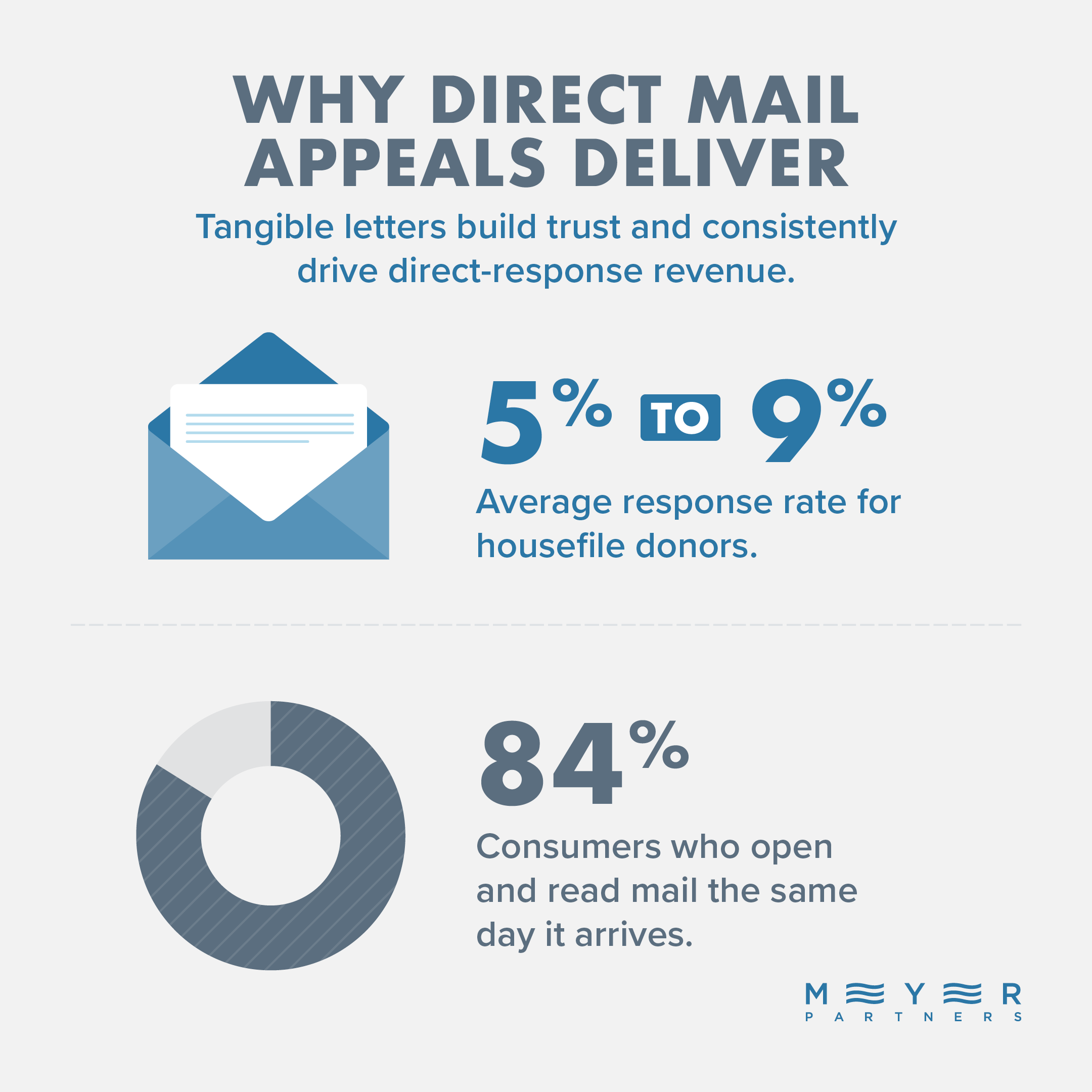
Direct mail cuts through digital clutter, consistently prompting giving and driving revenue for nonprofit organizations. A USPS study found that 84% of consumers open and read direct mail on the same day it arrives, underscoring how compelling this form of communication is.
This guide shows how to develop a direct mail strategy and craft appeals that resonate with your audience. We’ll cover:

Direct Mail Appeals: FAQs
What is a direct mail appeal?
A direct mail appeal is a physical fundraising package sent by postal mail to donors or prospects, requesting their financial support. These packages typically include an outer envelope, a personalized letter outlining a compelling need, and a response device such as a reply slip and return envelope.
What should you include in a direct mail appeal?
Every mailing requires a highly visible outer envelope designed to compel the recipient to open it. Inside, the package must include a donor-centric letter, a clear, specific call to action, and an easy-to-use reply form. Including localized inserts or impact reports can further strengthen your case for support by providing tangible proof of your organization's work.
Why do nonprofits still use direct mail appeals?
Physical mail offers highly reliable conversion rates, especially among established supporters. The average direct mail response rate for house lists (existing donors) ranges from 5% to 9%, drastically outperforming standard email marketing (where conversion rates range between 1% and 5%). Donors consistently trust tangible letters over digital communications when making substantial financial commitments.
When and how often should nonprofits send direct mail appeals?
Organizations typically anchor their direct mail calendars around year-end giving (November and December), alongside a spring renewal campaign and a fall acquisition push. At Meyer Partners, we also recommend sending mission-driven updates or donor newsletters in mid-summer (July or August) to keep your organization top of mind during months when donors usually do not hear from nonprofits.
Depending on the size of your donor file and your organization's budget, high-performing programs often mail active donors four to six times annually, aligning these physical touchpoints with major organizational milestones or seasonal needs.
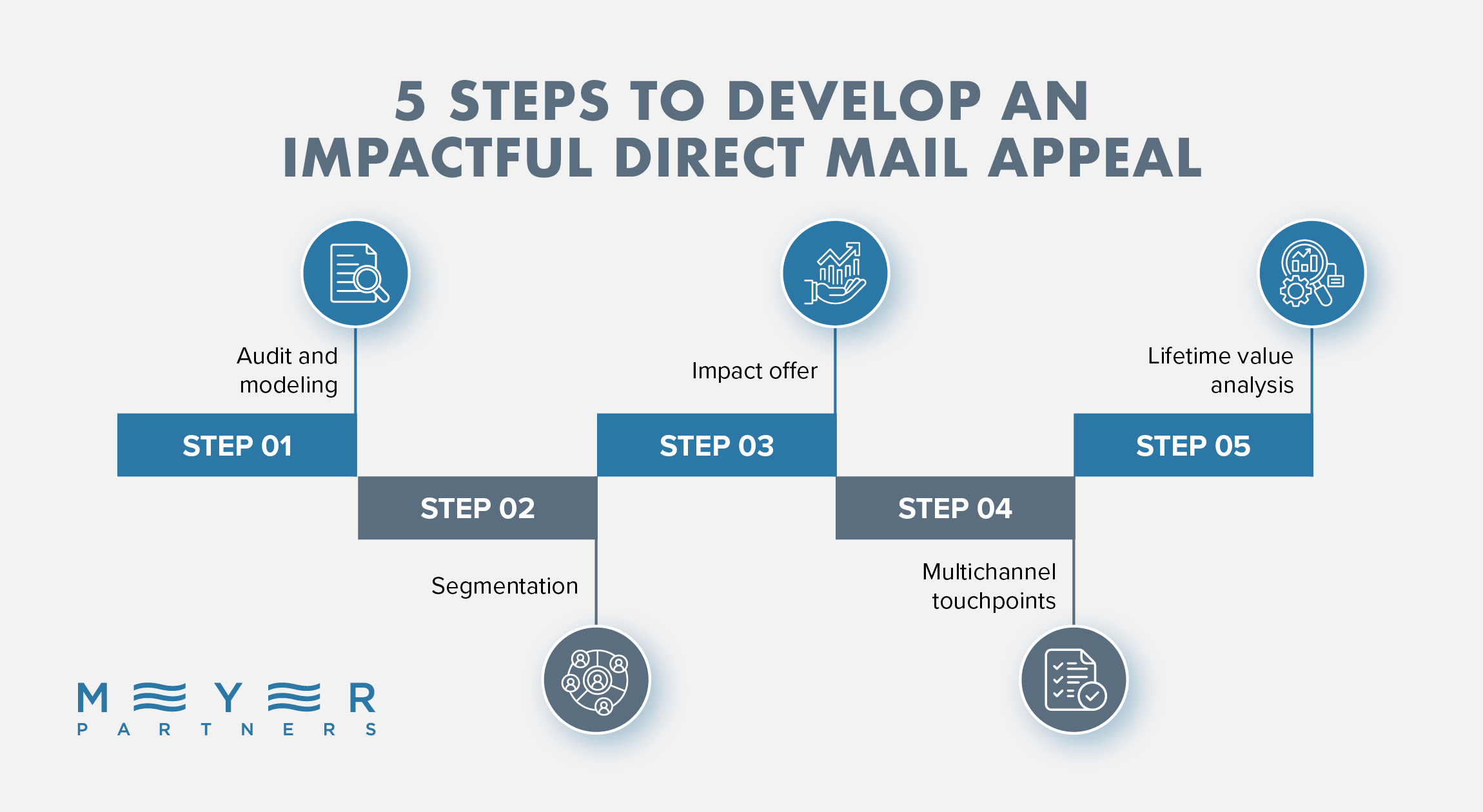
How to Develop a Direct Mail Appeal: 5 Steps
While physical mail cuts through digital noise and serves as the primary revenue engine for direct response fundraising, its success hinges on strategic preparation behind the scenes.
By following a structured development roadmap, your organization can eliminate wasted postage, deliver highly relevant messaging to every supporter, and maximize donor lifetime value (LTV). Here is the step-by-step process for building a direct mail appeal that drives measurable results.
Step 1: Conduct a donor file audit and predictive modeling.
Before writing a single line of copy, analyze the health of your donor database to determine where your acquisition, reactivation, and renewal opportunities lie:
Clean your data. Run your file through NCOA (National Change of Address) updates, CASS certification, and merge/purge algorithms. Eliminate duplicate records, deceased constituents, and out-of-date addresses to protect your campaign budget from unnecessary printing and postage costs.
Audit historical performance. Analyze recency, frequency, and monetary (RFM) giving metrics across previous campaigns to establish baseline response rates and average gift sizes.
Apply predictive analytics. Use statistical modeling to rank donors and prospects by their likelihood of giving. Predictive models help identify:
High-LTV prospects: Active multi-gift donors ready for an upgraded ask.
Reactivation candidates: Lapsed donors who retain a high statistical probability of giving again.
Lookalike acquisition lists: Cooperative database selects that mirror the transactional behavior of your best supporters.
Step 2: Execute behavioral audience segmentation.
Generic mailings to your entire donor file tend to result in lower response rates and message fatigue. Effective direct mail relies on behavioral and transactional segmentation. Make every appeal feel personal and relevant by taking these steps:
Segment by relationship stage. Divide your list into distinct operational buckets, such as active multi-gift donors, single-gift donors, lapsed donors (12–24 months), deeply lapsed donors (24+ months), and cold acquisition prospects.
Customize personalized ask arrays. Avoid uniform giving boxes across all segments. Tailor suggested giving levels (e.g., $35, $50, $100 vs. $100, $250, $500) to each individual’s past giving history to provide opportunities for gift upgrades that feel natural.
Tailor tone and messaging urgency. Adjust your letter opening and narrative based on the segment. For example, open lapsed donor letters with a warm thank-you for past support rather than an introduction. Ask a donor who contributed $15 to a previous campaign for a slightly larger $25 gift, rather than a $500 request.
Step 3: Craft a resonant impact offer.
A compelling appeal requires a clear, tangible offer—a concrete explanation of exactly what the donor's gift will accomplish right now. The most effective way to build this offer is by pairing specific dollar amounts directly with real-world outcomes.
Instead of simply asking for a contribution to your annual fund, connect the giving level to a tangible result. For example, rather than stating, "Please support our community programs," tell the donor, "A gift of $35 delivers five warm, nutritious meals to a homebound senior." This approach helps the reader visualize the immediate, physical problem their contribution solves, making their impact feel real and measurable.
Beyond the math, a resonant offer must also answer a critical question for the donor: Why now? Anchor your request in a timely context to create a sense of urgency that feels natural and intuitive. This could be an upcoming seasonal hurdle, a sudden increase in community need, or a fast-approaching campaign deadline. When you combine a tangible, dollar-tied outcome with a time-sensitive need, you inspire the donor to step in and make a difference today rather than putting off their support.
Step 4: Synchronize integrated multichannel touchpoints.
Direct mail drives the highest response rates, but combining physical mail with digital touchpoints increases overall campaign visibility and lifts net revenue across all channels. Here’s how to maximize the benefits of this integration:
Time digital touches with mail delivery. Coordinate email appeals, social media reminders, and digital display ads to launch precisely when your direct mail is projected to land in mailboxes.
Build campaign-specific landing pages. Ensure online donation forms match the visual look, headline copy, and specific offer featured in the physical mailing. Cohesive messaging builds trust and delivers a seamless giving experience for donors who choose to give online after receiving their letter.
Leverage high-touch follow-up. For high-scoring prospects or mid-level donors (such as the top 10% identified by your predictive model), layer in personalized follow-up touchpoints, such as a phone call or an SMS reminder within 48–72 hours of mail delivery, to boost conversion rates.
Step 5: Measure net revenue, cost-to-acquire, and LTV.
Once gifts begin flowing in, evaluate campaign performance beyond surface-level response rates to understand the true financial impact on your organization:
Track essential metrics. Measure response rate, average gift size, cost-to-acquire a donor (CTA), and cost-to-acquire a dollar (CTAD).
Focus on net revenue. Calculate total revenue minus all design, print, mailshop, and postage expenses. Evaluating net revenue ensures you are measuring actual bottom-line growth rather than gross receipts alone.
Forecast donor lifetime value (LTV). Track new donor conversion rates and second-gift rates over the following 6–12 months. By looking at a donor's LTV, you can view acquisition costs as a long-term investment rather than a one-time fee, helping you fine-tune your mailing lists for future campaigns.
Creating a strong direct mail appeal requires a mix of reliable data, donor-focused storytelling, and a willingness to keep improving. By using clean lists, tailoring your message to different donor habits, and pairing your physical mail with timed digital outreach, your appeals will consistently grab attention, boost your net revenue, and inspire long-term support.

4 Tips for an Effective Direct Mail Appeal
Making even the small details of your direct mail campaigns as compelling and engaging as possible will help you reach your revenue goals. Follow these best practices to optimize every aspect of your appeal:
Apply the three Rs of storytelling.
The three Rs of storytelling are foundational guidelines that help you craft appeals that speak to your audience and demonstrate your commitment to making donors feel like true partners in achieving your mission. The three Rs are:
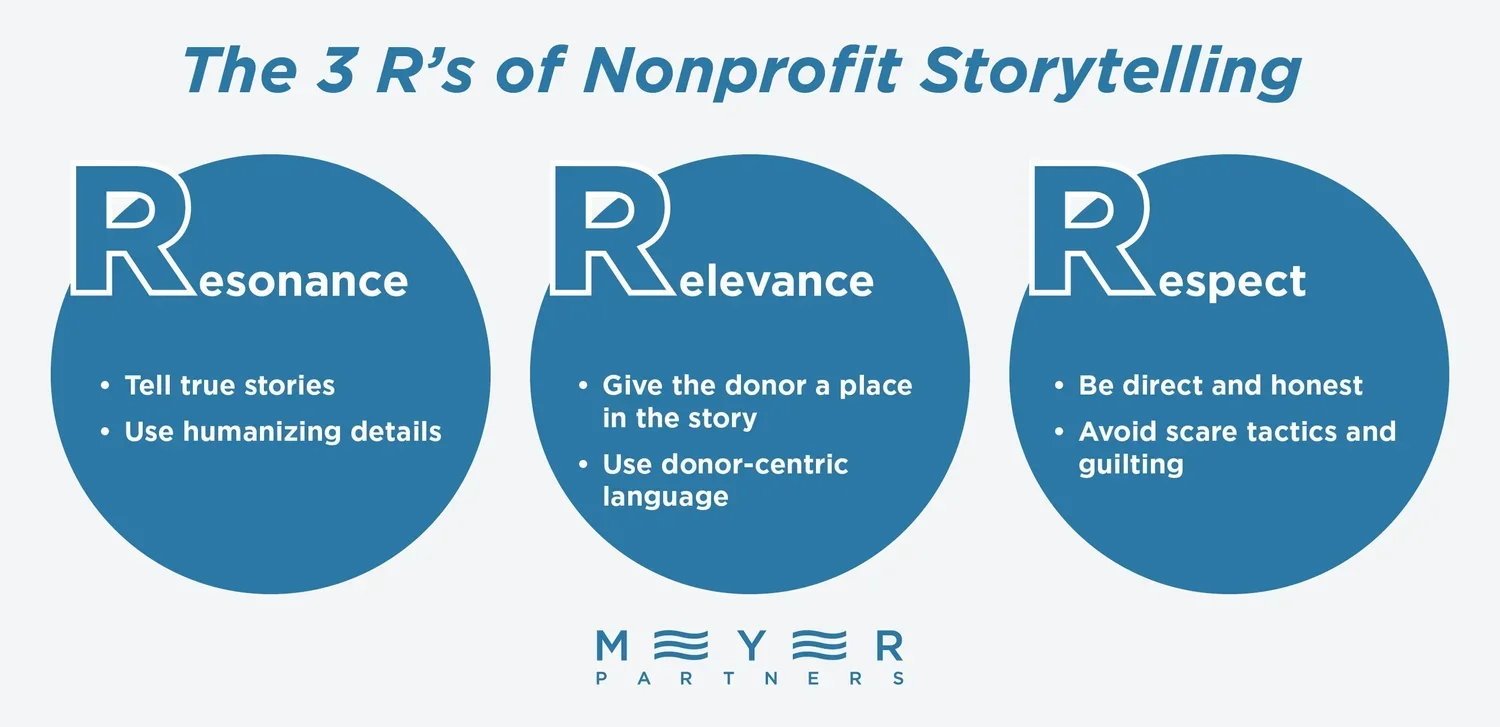
Resonance: Use authentic details from real constituent experiences rather than composite or exaggerated stories. Ground your narrative in specific, verifiable facts that build profound emotional trust with the reader.
Generic/exaggerated copy: "Countless families in our city are facing unimaginable tragedy and despair every single day, wondering if anyone cares about their suffering."
Resonant copy: "When seven-year-old Maya walked into the after-school pantry on Tuesday, she held her younger brother’s hand and asked if they had fresh apples today. Because a local farm delivery arrived that morning, Maya left with a box filled with fresh fruit, milk, and whole grains for her family."
Why it works: Specific names, days of the week, and tangible details (apples, milk, whole grains) create a vivid, truthful scene that builds immediate trust without resorting to melodramatic generalization.
Relevance: Put the donor in the story, using second-person "you" language to frame them as the protagonist who makes the outcome possible. Shift the focus away from the organization's greatness and directly onto the donor's agency and impact.
Organization-centric copy: "Our organization expanded its food distribution program by 25% this year, allowing our staff and volunteers to deliver over 50,000 meals across the region."
Relevant copy: "Because of your generosity, a senior like Ruthie doesn't have to face a cold evening alone. Your gift of $35 delivers five warm, nutritious meals directly to her door—and brings a friendly visitor to brighten her week."
Why it works: Replaces "our organization did X" with "your gift makes X possible," framing the donor as the active partner and hero of the outcome.
Respect: Communicate with dignity, avoiding manipulative appeals to urgency, guilt, or fear. Empower the people you serve by highlighting their resilience and ensuring your fundraising ethics align with your mission.
Fear-based copy: "If you don't give before midnight tonight, innocent children will be left in the dark with no hope. Don't turn your back on them when they need you most!"
Respectful copy: "Navigating a multi-year medical recovery requires immense courage. Families like Fatima's meet every surgical hurdle with resilience and hope. By joining her journey today, you walk alongside Fatima as a true partner in her care, ensuring she has the resources needed to heal and thrive."
Why it works: Honors the constituent's strength and dignity, inviting the donor into an authentic partnership rather than using guilt, pity, or artificial panic.
Make offers the visual hero.
Ensure special incentives, such as a 2X matching gift challenge or a milestone dedication, are prominent visual anchors across the outer envelope, letter copy, and reply slip rather than buried in body text. Use design techniques to guide the reader's eye directly to the most critical action items within seconds of opening the piece, including:
Bold typography
White space
Strategic callout boxes
Color contrast
For example, you might feature a prominent callout box near the top of your appeal or on the reply slip:
DOUBLE YOUR IMPACT! 2X MATCHING GIFT CHALLENGE
Every dollar you give before December 31st will be matched dollar-for-dollar by a generous board member—up to $50,000!
By elevating these incentives visually, you ensure that donors immediately recognize the potential impact of their support.
Personalize ask strategies.
Generic, one-size-fits-all ask strings (like offering $25, $50, and $100 options to every recipient on your list) leave significant revenue on the table. A $25 ask insults a $500 donor by under-aspiring their commitment, while a $500 ask can intimidate a reliable $35 supporter into taking no action at all.
By leveraging variable data printing (VDP) and donor database metrics, such as last gift amount (LGA) and highest previous contribution (HPC), you can dynamically customize greetings, letter copy, and reply-slip ask arrays for every recipient.
Use the following strategies to tailor every ask to each donor’s affinity and capacity for giving:
Use formulaic ask strings. Set rules based on past giving (e.g., Option 1 = 1.2x Last Gift, Option 2 = 1.5x Last Gift, Option 3 = 2x Last Gift).
Reference past giving directly. Use mail merge fields in the letter body to reference the donor's previous gift date, specific program supported, or giving milestone.
Customize the salutation and tone. Move beyond generic greetings ("Dear Friend") to personalized openings that acknowledge the donor's unique relationship stage (e.g., "Dear Marcus, as a monthly partner for over three years...").
Imagine your organization is sending out a spring appeal letter to upgrade existing supporters. Rather than sending the exact same letter package to everyone, variable data printing customizes the experience for two distinct supporters on your housefile:
Donor A: Sarah (grassroots donor)
Giving history: Contributed $35 to your holiday appeal six months ago.
Personalized letter greeting: "Dear Sarah, thank you for standing with us this past December..."
Letter copy ask: "Will you consider taking the next step in your partnership with a gift of $50 today?"
Reply slip ask array: [✓ ] $50 [ ] $75 [ ] $100 [ ] Other: $____ (Pre-checked default: $50)
Impact tie-in: "Your $50 gift provides two full weeks of fresh groceries for a local family."
Donor B: Marcus (mid-level donor)
Giving history: Gives $500 annually every spring for the past four years.
Personalized letter greeting: "Dear Marcus, as one of our most faithful community partners..."
Letter copy ask: "Will you help us meet our spring challenge by stepping up with a leadership gift of $650?"
Reply slip ask array: [ ✓] $650 [ ] $1,000 [ ] $1,500 [ ] Other: $____ (Pre-checked default: $650)
Impact tie-in: "Your $650 gift equips an entire neighborhood center with emergency supplies for the year."
By dynamically tailoring the ask, Sarah is gently upgraded by $15 without feeling priced out, while Marcus is challenged to increase his commitment by $150, thereby maximizing net revenue potential at both ends of your donor file and ensuring every supporter feels uniquely recognized.
Design for tactile engagement.
Direct mail’s greatest asset is its physical, sensory presence. The weight of the paper, the texture of the envelope, and the visual flow of the letter send immediate signals to the donor about your organization’s credibility and authenticity.
To ensure your package feels personal, official, and worthy of attention when held in a donor's hands, focus on these core design elements:
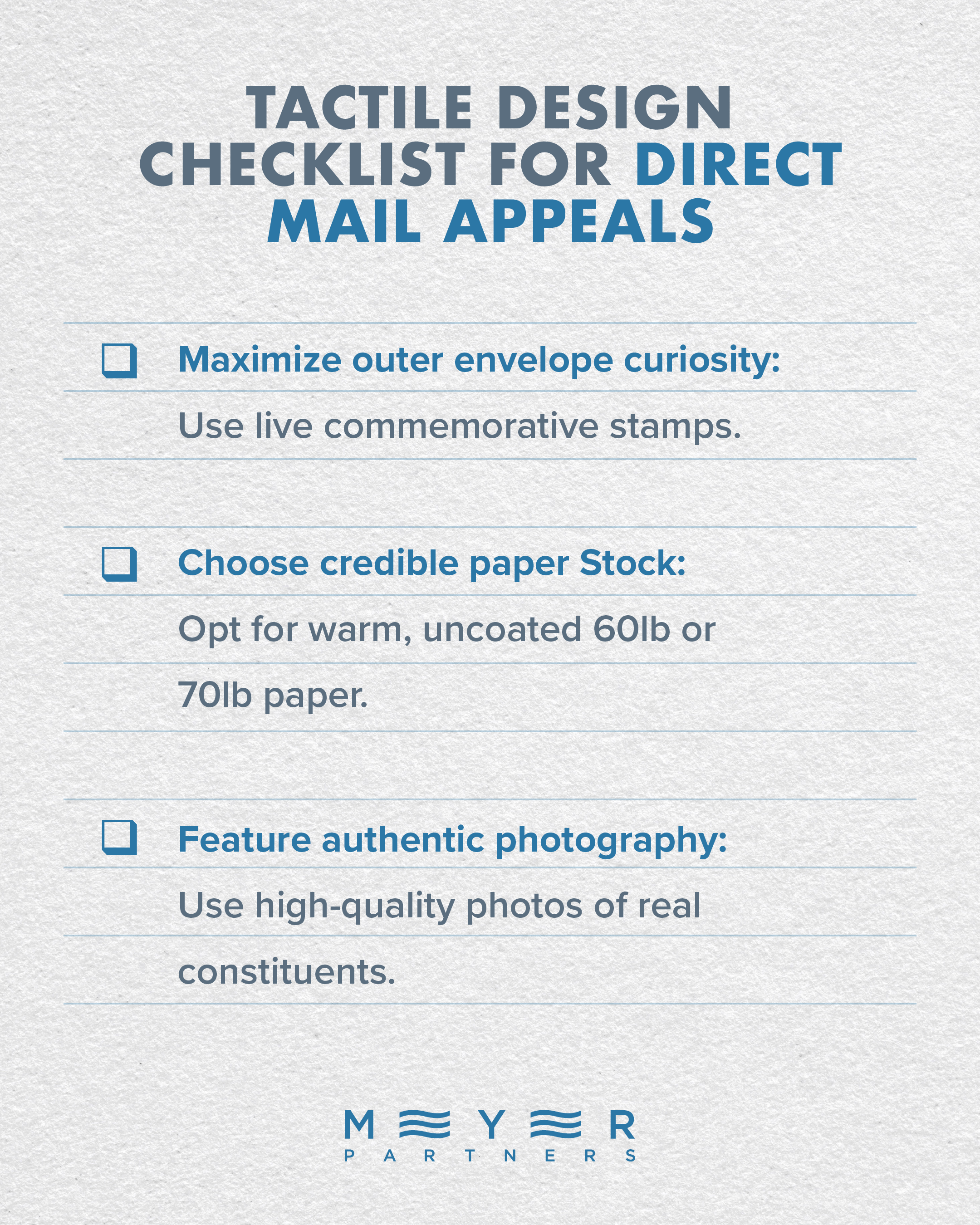
Maximize outer envelope curiosity. Swap standard window envelopes and pre-printed stamps for clean, closed-face envelopes with unique commemorative stamps. Drive open rates by either keeping the exterior purely official or adding a strategic teaser (like a matching gift banner) and a pattern interrupt (such as simulated handwriting or a Post-it note).
Choose credible paper stock. Opt for warm, uncoated 60lb or 70lb offset paper. This provides a sturdy, authentic feel while avoiding slick, high-gloss stocks that look like wasteful commercial advertisements.
Feature authentic impact photography. Create an immediate emotional connection by using a single, high-quality photograph of a real constituent rather than generic stock images or cluttered photo collages.
Direct Mail Package Template
While every campaign requires a unique narrative, the most successful direct mail appeals follow a proven structural framework. Use this template to ensure your next package includes all the essential components for maximizing donor conversion and net revenue.
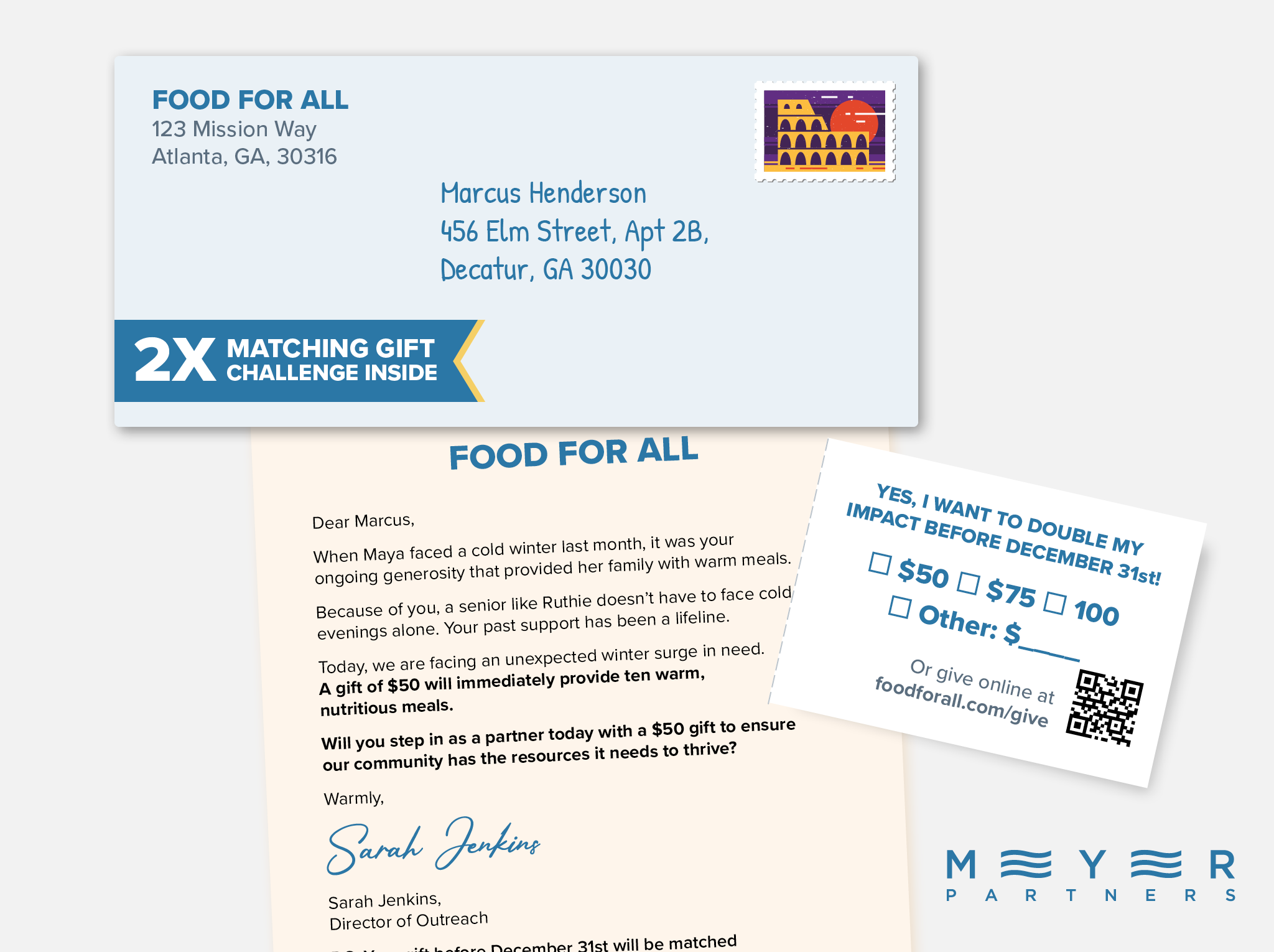
1. The outer envelope
Format: Closed-face envelope with a live commemorative stamp.
Visual teaser (optional): Strategic callout box or text (e.g., "2X Matching Gift Challenge Inside").
Goal: Spark curiosity and prompt immediate opening rather than discarding as bulk mail.
2. The appeal letter
Personalized salutation:
Template: Dear [Preferred First Name],
Strategy: Avoid "Dear Friend." Customize based on the relationship stage (e.g., "Dear Marcus, as a monthly partner for over three years...").
The hook and acknowledgment (paragraph 1):
Focus: Lead with gratitude and center the donor's past impact.
Example: "When [Constituent Name] faced [specific challenge] last month, it was your ongoing generosity that provided [immediate solution]."
The problem and narrative (paragraphs 2–3):
Focus: Apply the Three Rs (Resonance, Relevance, Respect). Share a single, verifiable story of a constituent facing a current hurdle. Keep paragraphs to 2–3 sentences.
The impact offer and context (paragraph 4):
Focus: Explain exactly what a contribution will accomplish right now and why it is urgent.
Example: "Today, we are facing an unexpected [seasonal/community hurdle]. A gift of [Target Ask Amount] will immediately provide [tangible, real-world outcome]."
The direct ask (paragraph 5):
Focus: Clear, unequivocal call to action using second-person "you" language.
Example: "Will you step in as a partner today with a gift of [Target Ask Amount] to ensure [Constituent Name/Community] has the resources they need to thrive?"
Sign-off:
Format: Simulated blue-ink signature from a key organizational leader to contrast with the printed text.
The postscript (P.S.):
Focus: Never skip the P.S., as skimmers often read it first. Restate the core offer, the specific deadline, and any matching incentives.
3. The reply device (remittance slip)
Offer header: Reiterate the campaign's primary visual hero or incentive (e.g., "Yes, I want to double my impact before December 31st.").
Personalized ask array: Use variable data printing to scale the suggested giving levels based on the donor's highest previous contribution (HPC) or last gift amount (LGA).
Template: [ ] [1.2x LGA] [ ] [1.5x LGA] [ ] [2x LGA] [ ] Other: $____
Uncluttered response fields: Include pre-printed donor contact information, large check boxes, and clear payment options (including a prominent QR code for online giving).
Altogether, your direct mail appeal could look something like this:
Wrapping Up
Direct mail isn't—and never was—dead. In an increasingly noisy digital world, a well-crafted physical appeal offers the personal touch and tangible connection donors need to feel truly engaged. By understanding your audience, relying on donor-centered storytelling, and tracking long-term metrics, your organization can create direct mail appeals that cut through the clutter and drive lasting support.
Need help taking your direct mail strategy to the next level? With over 35 years of experience in direct response fundraising, the team at Meyer Partners helps nonprofits build data-driven campaigns and authentic storytelling strategies that raise more for your mission. Speak to an expert today to see how we can support your fundraising goals.