
Donor Analytics: How To Turn Numbers into Nonprofit Strategy

Donor analytics tell you everything you need to know to drive donations and cultivate stronger relationships with supporters.
For today’s nonprofits, the challenge isn’t just finding generous supporters—it’s about understanding and valuing those supporters over their entire lifetimes. Analyzing metrics related to who your supporters are and what motivates them is the key to achieving that.
In a competitive fundraising environment, your organization can’t rely on assumptions. Instead, you need to leverage data to foster meaningful connections that last. Donor analytics provides the essential intelligence to turn raw data into a relational strategy that sustains your mission.
To empower your team with data-backed insights, this guide will break down the power of donor analytics and provide practical applications for your outreach and fundraising efforts. Here’s what we’ll cover:
We’ll show you the roadmap for turning raw data into confident action! Let’s start by answering some fundamental questions.

Donor Analytics FAQ
What is Donor Analytics?
Donor analytics is the systematic process of collecting, organizing, and interpreting individual supporter data to gain actionable insights into donor behavior and motivations. The ultimate goal is to translate this information into decision-making intelligence that informs overall fundraising strategy, enables personalized communications, and maximizes donor lifetime value (LTV).
Know that the terms “donor analytics” and “donor data” are not interchangeable. Donor data is the raw information—the individual’s gift history, name, address, event attendance record, and more. Donor analytics is the systematic process of drawing conclusions from that raw data, or the conclusions themselves. This distinction is important because the power isn't in collecting the data, but in committing to the analytical process.
Why Should Nonprofits Use Fundraising Data Analytics?
Using data to inform your fundraising and outreach strategies is the most reliable way to ensure sustained growth. Donor analytics transforms your approach from a guess-based effort to strategic science.
Nonprofits that leverage donor data effectively benefit in these ways:
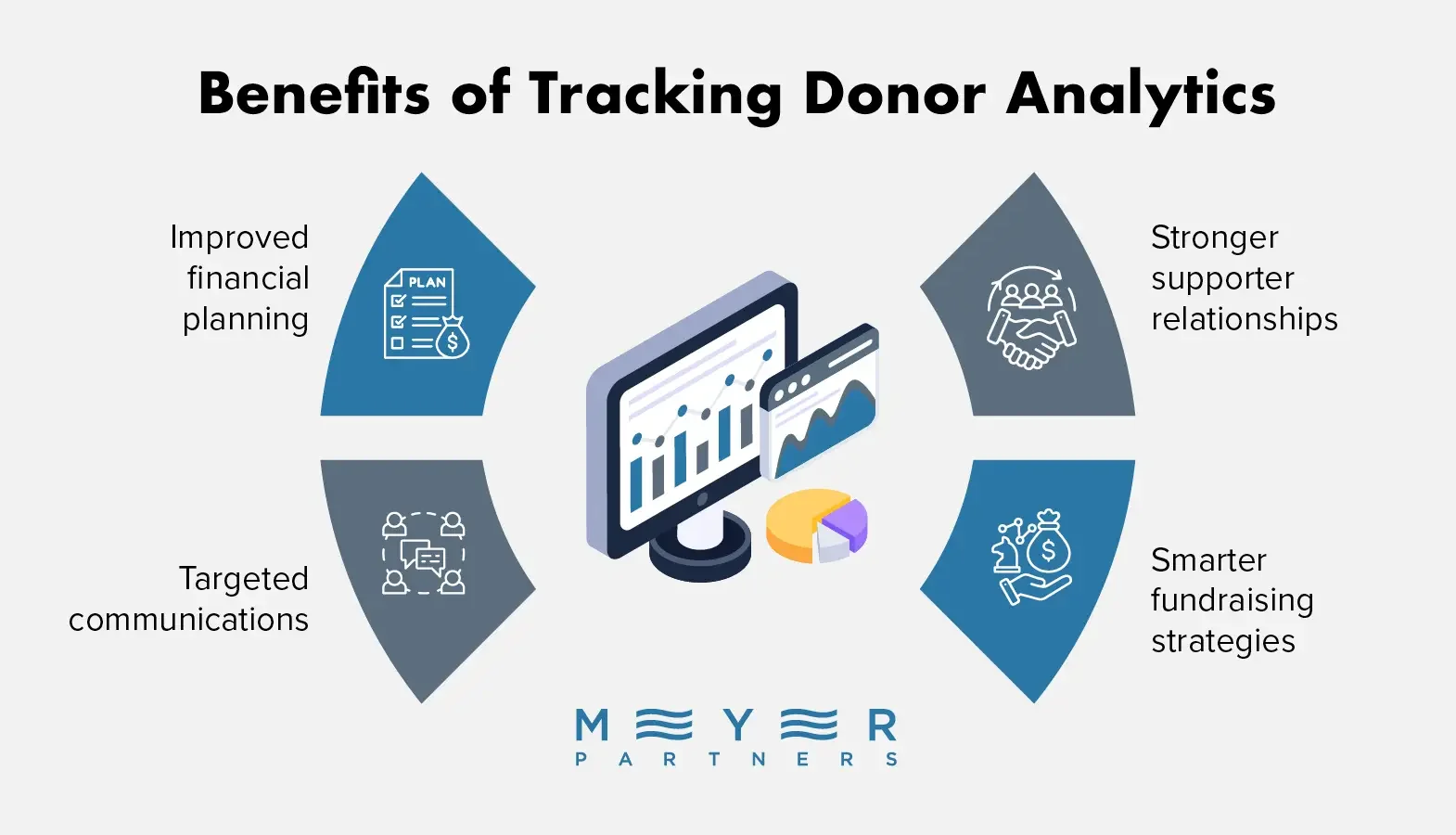
Targeted Communications and Campaigns: Data analysis provides insights into donor communication preferences and optimal contact frequency, allowing you to respect each donor’s time and avoid wasting your resources.
Improved Financial Planning: Through data analysis, you gain a clear, long-term view of your supporter file, guiding smart resource allocation toward strategies that promise the greatest net return.
Stronger Supporter Relationships: By understanding a donor’s giving history, communication preferences, and specific interests, you can send tailored communications with relevant engagement opportunities, transforming transactional givers into lifelong partners.
Smarter Fundraising Strategies: Donor analytics, particularly through predictive modeling, enables you to answer complex questions about who is most likely to give and how to best ask them. Plus, you can spot high-value prospects by predicting capacity for major gifts. This maximizes revenue through fewer, smarter asks.
Even with all of these benefits, data literacy is a challenge for over 75% of nonprofit organizations, according to Data Orchard’s nonprofit data maturity report.
Understanding the numbers associated with your nonprofit and crafting an effective approach to donor data analytics improves every part of your supporter relationships and fundraising efforts. This starts with collecting and analyzing the right information, which brings us to our next section.
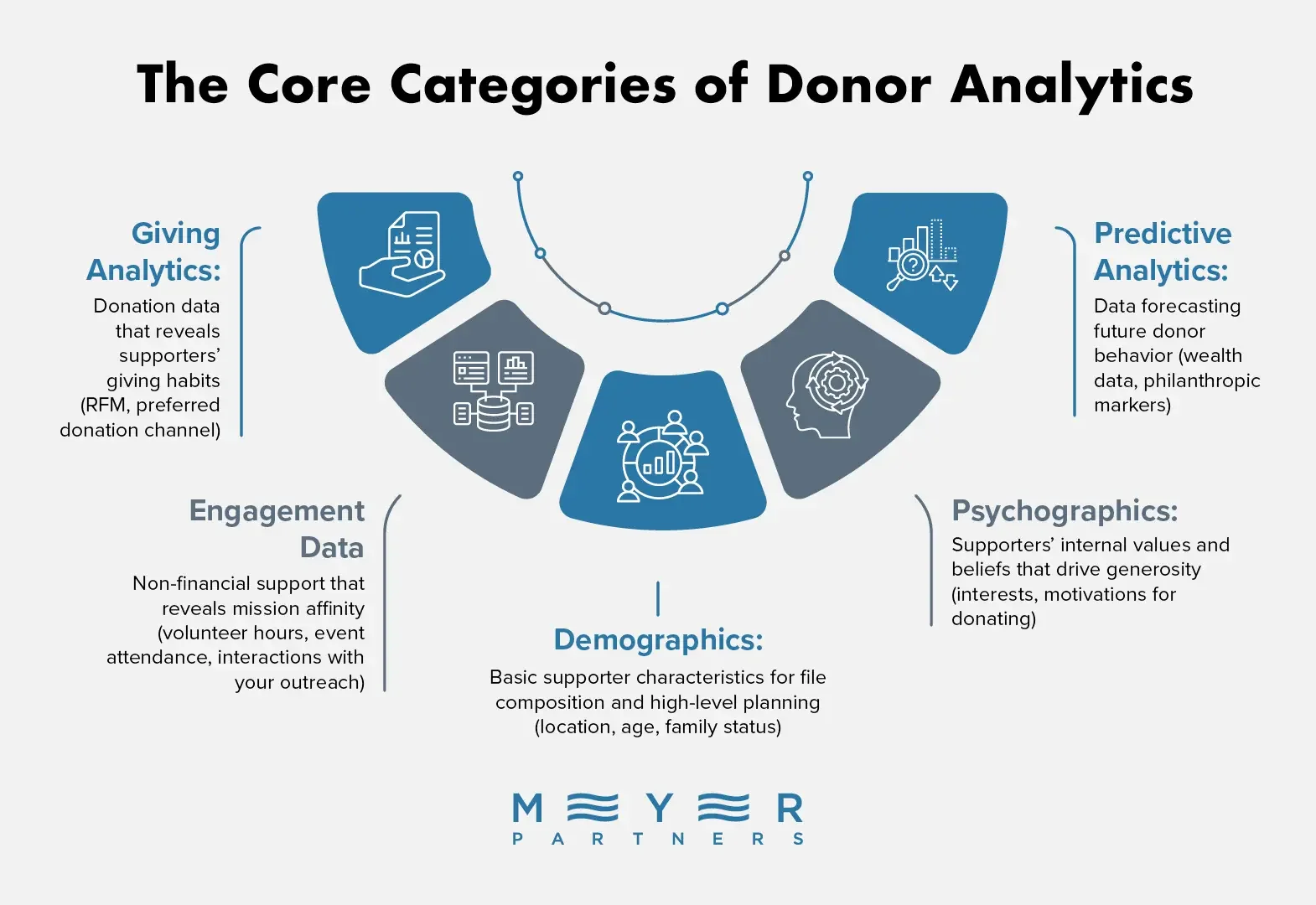
The Five Core Types of Donor Analytics
With this foundational knowledge in place, you’re ready to jump into the specific categories of donor data you should gather and how to draw conclusions from each one to drive greater, more efficient results for your mission.
Giving Analytics
These are the foundational financial metrics that detail what and how often a donor contributes. The conclusions you draw from donors’ giving behaviors are essential for segmentation and for tailoring ask amounts in your appeals.
Here are the key data points and the actionable conclusions you can draw from them:
Average Donation Amount: The mean size of financial gifts you receive helps you set appropriate ask strings for different segments. This way, you won’t ask a loyal, high-level donor for a generic, low amount or a small donor for a major gift.
Recency of Giving: Considering the date of the donor’s last contribution, you can determine which communication track they belong to: active, cultivation, or recapture.
Frequency of Giving: How often a donor contributes (e.g., annually, quarterly, sporadically) helps you identify loyal donors, pinpoint candidates for monthly giving, and inform the appropriate intensity of your cultivation strategy.
Preferred Contribution Channel: The method used to make a contribution (e.g., direct mail, online, phone) helps you optimize response mechanisms—the trackable tool (like a unique URL, reply card, or text-to-give code) that makes the act of giving frictionless.
In-Kind Donations: Non-cash contributions and their assigned financial values help you understand a supporter’s overall generosity and mission commitment. For instance, knowing that someone enjoys making in-kind donations, an animal shelter might ask for new toys, food, and beds for pets in their care.
By successfully mapping these fundraising data analytics, you move past random appeals and can confidently invest in segments that show the highest LTV. For example, let’s say your analysis shows a segment’s recency score is too low to statistically justify the postage cost of a full direct mail appeal. You’ll instantly know that your budget is better reallocated to proven segments.
Engagement Analytics
This data focuses on a supporter’s non-financial interactions, offering a window into their affinity for and relationship with your mission. The conclusions you draw from this data can often signal a high propensity to give, pointing you toward potential major donors to cultivate.
Consider these donor engagement analytics and the insights you can draw from them:
Interactions with Outreach: Tracking responses to direct mail appeals, email open/click rates, and digital participation provides feedback on how well your messages resonate and which channels motivate action.
Volunteer Hours: Monitoring time spent volunteering or supporting mission delivery helps identify supporters who have deep, personal connections to your cause beyond financial support.
Event Attendance: Analyzing which events a supporter attends and how frequently they participate signals their level of active interest in your organization’s community, indicating high cultivation potential.
Advocacy Campaign Participation: Tracking involvement in advocacy efforts (e.g., petitions and letter-writing) confirms a supporter’s dedication to your mission’s outcomes and their willingness to publicly support your cause.
Feedback Provided: Capturing direct feedback via surveys and social media comments gives critical context to giving motivations, communication preferences, and potential pain points.
Peer-to-Peer Fundraising Participation: A donor raising money on your behalf shows they are willing to advocate for your mission publicly, marking them as a high-influence supporter.
When you map these non-financial actions to supporters’ giving patterns, you gain essential intelligence for moving engaged, low-level donors into a mid-level cultivation track. For example, let’s say your event attendance analysis shows a supporter has attended four non-fundraising events but has only given $50. You might move them into a personalized, high-touch cultivation journey, knowing their affinity is high but their financial potential is untapped.
Demographic Analytics
These metrics detail the basic characteristics of your donors. While we advise against using demographics to rigidly tailor campaigns, these conclusions are useful for understanding the broader composition of your donor file and informing high-level planning.
Here are the key data points and conclusions you might make from them:
Location: Analyzing location data helps ensure communications are geographically relevant and assists with optimizing list rental efforts for new donor acquisition.
Marital and Family Status: Tracking whether the donor is married helps ensure that salutations and address information are correct in your direct mail pieces.
Education and Employment: Information about educational background and professional status helps you understand the general profile of your supporter base for macro-level analysis.
Age and Gender: Using basic profile metrics allows for file segmentation and high-level trend analysis to identify where your core support lies.
Analyzing the composition of your file ensures your donor acquisition efforts target the audiences most likely to respond. For example, analyzing marital status alongside address data ensures personalized direct mail salutations in your acquisition mailings are respectful and accurate (e.g., “The Smiths” vs. “Ms. Jane Doe”).
Psychographics
This data category moves beyond simple financial and action-based metrics to detail the supporter’s internal drivers, such as their values and beliefs. Understanding these motivations allows for empathetic and resonant storytelling in your appeals.
Here’s how you might analyze and synthesize different types of psychographic data:
Motivations for Supporting Your Cause: Using the reason cited for their first or most recent gift allows you to categorize donors by their core passions (e.g., education, emergency relief) to better tailor future content and engagement opportunities.
Interests and Values: Analyzing self-reported interests or demonstrated philanthropic values helps you select stories and messaging themes that will elicit the deepest emotional response and improve content relevance.
Communication Preferences: Tracking how the donor prefers to be contacted (e.g., mail frequency, digital opt-ins) enables respectful donor stewardship. You’ll be able to maximize the effectiveness of donor communications without risking attrition when you respect preferences.
True personalization is based on a donor’s beliefs, not just their wallet. Effectively analyzing these psychographics leads to more authentic and effective communications. For example, donors whose primary interest is community service should receive appeals focused on local impact, while those interested in national research should receive content about scientific breakthroughs and global reach.
Predictive Analytics
You can use historical data and statistical models to forecast future donor behavior. The conclusions drawn here drive direct action, allowing you to optimize campaigns before they launch.
Try collecting and analyzing these data points to make informed predictions about a donor’s future engagement:
Propensity to Give: Using a statistical score indicating the likelihood a donor will make a gift at any given time allows for precisely timed and highly targeted appeals, maximizing response rates and minimizing communication fatigue.
Wealth Data: Analyzing external financial and asset indicators (e.g., real estate and stock holdings) gauges a supporter’s capacity to give a major gift, helping to focus cultivation efforts on the highest-potential targets.
Philanthropic Markers: Tracking giving history to other similar organizations suggests a high likelihood of future support for your mission, making these prospects prime targets for acquisition campaigns.
The conclusions you draw here empower you to move from reactionary fundraising to proactive, high-yield strategic investment. Let’s say your models predict that a loyal donor is likely to stop giving soon. The smart decision is to quickly reach out with a low-cost, personal effort, like a phone call or a direct mail letter, to ensure they don’t lapse.
How to Apply Donor Analytics to Drive Results
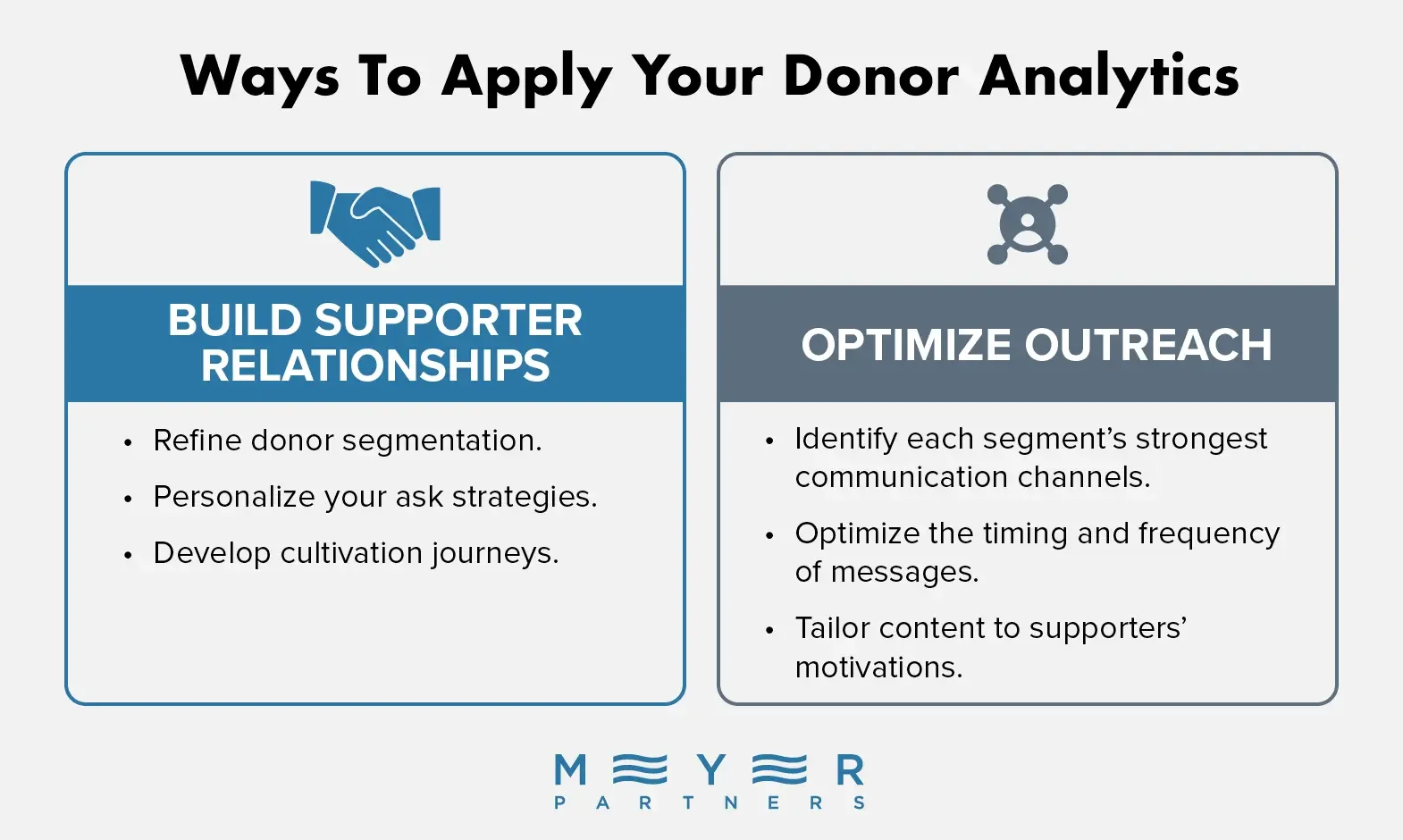
Once you have transformed your donor data into decision-making intelligence, the next step is applying those insights directly to your communications and strategic direction. This is where nonprofit donor analytics translate into measurable fundraising success. While we’ve covered some applications, here are two areas where your donor analytics approach really makes a difference:
1. Building Supporter Relationships
The purpose of donor analytics is to foster long-term loyalty by upgrading supporters and moving them toward greater commitment to your mission. Backed by the right insights, here’s how you might adapt your approach to stewarding long-term relationships:
Refine donor segmentation. Move beyond grouping supporters by simple gift amount. Instead, use a combination of giving, engagement, and predictive data to ensure appeals have high conversion potential. After all, effective segmentation can drive a 760% increase in revenue.
Personalize your ask strategies. Fundraising data analytics enable you to move beyond generic appeals and implement personalized asks, such as dynamically generated ask strings in your direct mail reply form based on previous giving history.
Develop cultivation journeys. Donor analytics should inform your year-round cultivation approach. You’ll be able to offer continuous value by educating donors and offering meaningful opportunities that nurture relationships.
2. Optimizing Outreach
Donor analytics allows your nonprofit to reach the right supporters with the right message at the right time. By applying your insights strategically, you can dramatically improve your nonprofit’s marketing efficiency and response rates. Here’s how to focus your efforts where they matter most:
Identify each segment’s strongest communication channels. Use engagement data to determine where donors reliably respond (e.g., direct mail, email, SMS, social media, etc.). Prioritizing the channels proven to work for each audience ensures you’re investing in the methods that generate the highest ROI.
Optimize message timing and frequency. Recency and frequency data reveal when donors are most receptive. With that knowledge, you can time appeals, updates, and reminders to match donor behavior and reduce fatigue while increasing conversions.
Tailor content to supporters’ motivations. Psychographic data gives deep insight into what donors care about. Aligning stories, calls to action, and impact messages with those motivations creates more relevant, compelling outreach that drives higher engagement.
By using audience insights, Meyer Partners develops communication strategies that are precisely tailored to your donor base. Our approach ensures your organization moves beyond generic mass appeals to deliver highly personalized outreach that maximizes both response rates and fundraising revenue. This focus on analytical rigor and targeted messaging is how we help nonprofits achieve measurable growth.

Best Practices For Smarter Donor Data Analytics
Strong donor analytics require consistent, thoughtful practices that keep your data accurate, actionable, and aligned with your organization’s goals. By implementing the following strategies, you’ll ensure that your insights remain reliable and your fundraising decisions stay rooted in real supporter behavior:
Practice good data hygiene. Conduct regular data audits, deduplicate supporter records, and create clear data entry standards. Clean data ensures every analysis, segmentation effort, and model is built on accurate information.
Create detailed supporter profiles. Consolidate each donor’s giving history, engagement activity, preferences, and predictive scores into a single record within your nonprofit’s CRM. Having a single source of truth allows for more precise segmentation and personalization.
Leverage outside analytics expertise when needed. Partner with specialists (such as the consultants at Meyer Partners) who can support advanced data analysis, predictive modeling, and comprehensive file audits.
Ensure your systems integrate. Connect your CRM, email platform, donation forms, mailhouse, and reporting tools so data flows seamlessly between systems. This reduces manual work and ensures consistency across outreach and reporting.
Adapt your nonprofit donor analytics strategy. As your organization evolves, revisit your tracking practices and KPIs regularly to ensure they align with current fundraising priorities and organizational goals.
By following these donor analytics best practices, your nonprofit can turn its data into reliable intelligence that guides smarter decisions. With a strong foundation in place, every campaign becomes more targeted, efficient, and poised for success.
Wrapping Up
Donor analytics is the engine that converts raw donor behavior into actionable intelligence, ensuring every dollar invested in outreach and fundraising works harder to build lasting connections with passionate supporters.
Instead of just sitting on a mountain of data, start collecting and analyzing meaningful data that tells you who your donors are, what inspires them to give, and how you can better tailor engagement opportunities to pique their interest.
As you start working on your donor analytics strategy, check out these resources to put your data to work:
10+ Professional Fundraising Consultants That Drive Results. If your nonprofit struggles with data, consider working with one of these professionals who can synthesize your donor data and use it to power your campaigns.
Donor Pyramid: How to Use this Flexible Fundraising Tool. Discover how to use a donor pyramid to analyze your supporter base, identify gaps in giving, and apply those insights to your cultivation efforts.
Navigating Donor Communications with Ease: Best Practices. Learn how to craft targeted messages that catch donors’ attention.
Charity Abate
Charity Abate is a fundraising strategist and client service professional who leverages her 25 years of experience to create marketing and fundraising solutions that advance the mission of an array of nonprofit client organizations. She is passionate about analytics, recurring giving, and helping faith-based organizations grow their sustainable fundraising programs.